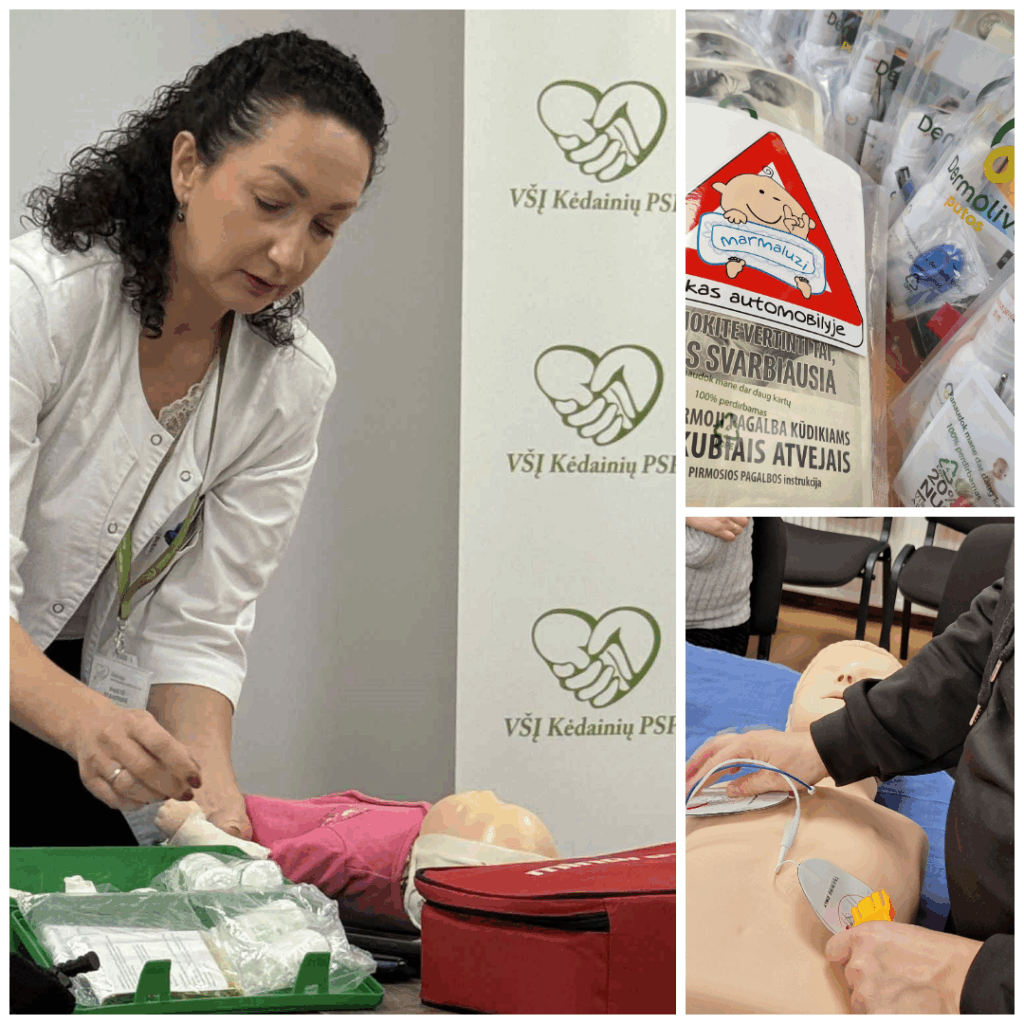
Visitors of the Kėdainiai District Maternity School gathered for the last theoretical and practical session of the programme "Promoting a Healthy Start in Life" "First Aid for Babies in Emergencies"
On 4 November, the lecturer Danutė Šilkaitienė, first aid instructor and health training organiser at the Kėdainiai PSPC, presented the sequence of actions in emergency cases, the basic principles of first aid for infants and children in case of choking, unconsciousness, signs of life, bleeding, burns etc.
First aid actions always depend on the presence or absence of signs of life and the nature of the injury or trauma. In the event of a medical emergency, it is important to create a safe environment, assess for signs of life and/or injuries and call an ambulance by dialling the general emergency number 112.
The meeting discussed the main possible situations. One of them is when the baby is CONSCIOUS but breathing. First aid - lay the baby on its side in a stable position (this will ensure airway patency).
FIRST AID FOR CHOKING. Strokes to the perineum.
- The person providing assistance must sit or kneel down so that they can safely place the baby in their lap.
- Hold the baby's head by placing the thumb of one hand on the corner of the lower jaw and grasping the other corner of the lower jaw with one or two fingers of the same hand.
- With the palm of one hand, strike 5 sharp blows to the perineum.
If the situation remains unchanged, continue resuscitation with chest compressions.
- Lay the baby on its back, head down. A safe way to do this is to put your baby on your free arm and grasp the back of her head with your fingers.
- Hold the baby by placing your hand along (or across) the thigh.
- Identify the location for the chest clicks (at the lower part of the sternum, one finger above the cardiac sternal process).
- Perform 5 chest clicks.
If the foreign body has not been removed and the baby has lost consciousness, assess the condition and start resuscitation at a ratio of 2:30.
CHEST COMPRESSIONS AND INITIAL RESUSCITATION.
- Do 5 puffs and if there is no response (the child does not move, cough or breathe on his/her own), move on to chest compressions without assessing blood flow. Resuscitate for about one minute, then call GMP (if someone else has not already done so).
- When you open your airway to make a puncture, look in your mouth for a foreign body.
- If a foreign body is visible, try to remove it with a single finger movement (do not try to remove a round foreign body, as you may push it deeper!) .
- If the obstruction has been removed, open and check the airway as described above. If the child is not breathing, continue the infusions.
- If the child regains consciousness and starts to breathe sufficiently on his/her own, put him/her in a stable lateral position and monitor breathing and level of consciousness until GMP arrives.
- If you have not removed the foreign body, continue resuscitation until the medics arrive.
FIRST AID IN CASE OF BURNS.
- Cool the burned area with running water at room temperature for 10 to 20 minutes (this can significantly reduce the area of the burn and pain).
- Cover with a dry, clean dressing.
- It is very important not to remove clinging, soaked clothes, apply ointments or puncture blisters.
In addition to the theoretical recommendations, the participants had the opportunity to learn practical first aid skills in acute situations using infant and adolescent manikins, as well as to get acquainted with the use of a defibrillator for both children and adults.
Participants of the last session of the programme "Promoting a Healthy Start in Life" were given gifts: information material on first aid and injury prevention, disposable artificial respiratory masks and reflectors. The gift baskets were also filled with GENBA PHARMA products.
The programme "Promoting a Healthy Start in Life" is funded by Kėdainiai District Municipality.