Taking care of your health is RESPONSIBLE. Getting tested is BRAVE. Knowing your status is IMPORTANT!
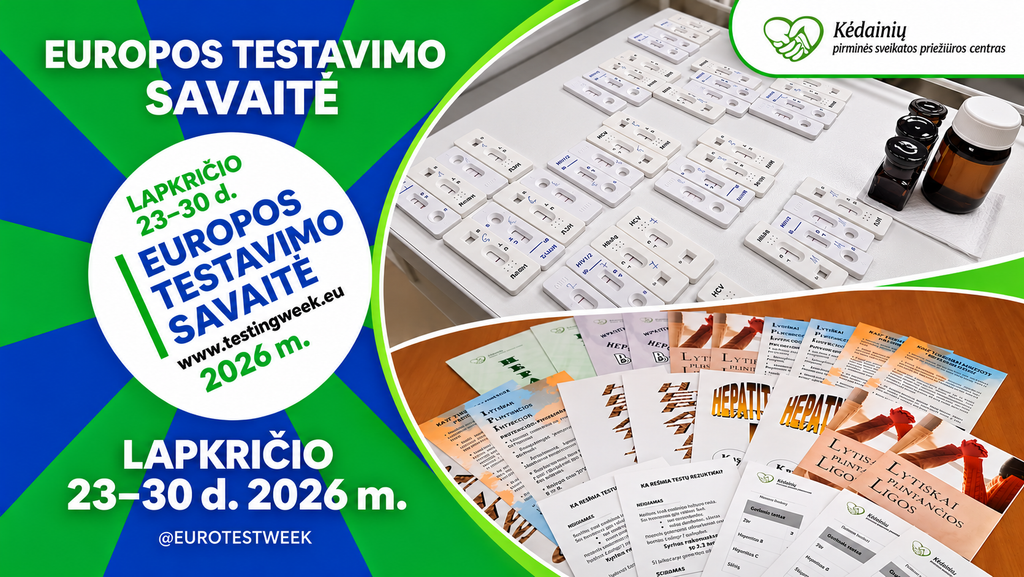
European Testing Week is observed from November 23 to 30, during which the public is encouraged to pay more attention to the prevention and early diagnosis of HIV, sexually transmitted infections (STIs), and viral hepatitis B and C.
The Kėdainiai Primary Health Care Center, through its implementation of low-threshold service projects funded by the National Center for Addiction Treatment and the Kėdainiai District Municipality, is actively contributing to the European Testing Week initiative. Low-threshold service staff visit various institutions whose specific activities involve a higher risk of exposure to infectious diseases and conduct rapid tests there.
During European Testing Week, as many as 144 rapid tests for HIV, viral hepatitis B and C, and sexually transmitted infections have already been conducted.
Early detection of infections is extremely important—it allows individuals to seek timely care from healthcare professionals, begin the necessary treatment, avoid potential complications, and reduce the risk of spreading infections. If the rapid test result is positive, the individual is informed about the next steps and referred to consult with the appropriate healthcare professionals and undergo additional confirmatory tests.
Would you like to take rapid tests for HIV, hepatitis B and C, and syphilis anonymously and free of charge at a time that’s convenient for you? Please visit the Mental Health Department at the Kėdainiai Primary Health Care Center (Office No. 1) or call 0 611 10420 or 0 695 18681—we’ll arrange a date, time, and location for your appointment.
Who is advised to get tested for HIV?
- if the cough lasts longer than a month;
- you frequently (more than twice a year) suffer from pneumonia, bronchitis, throat infections, ear infections, and other infections;
- if you have a fever that lasts longer than a month;
- if you have been experiencing diarrhea for more than a month;
- you have lost a significant amount of weight (more than 10 percent) for no apparent reason;
- if you constantly feel tired and weak; if you sweat profusely at night;
- if you contract tuberculosis;
- swollen lymph nodes in the neck, armpits, or groin;
- if you have candidiasis of the genitals, mouth, esophagus, or throat;
- If you have sores in your mouth or on your genitals that do not go away for more than 1 month.
Who is advised to get tested for viral hepatitis B and C?
- if you received a blood transfusion or blood products before 1993;
- if you have undergone surgery (including a C-section) or invasive procedures;
- if liver enzymes (ALT, AST) are elevated for unknown reasons;
- patients on hemodialysis; patients with hemophilia and other blood disorders;
- organ and blood donors;
- people who have undergone organ transplants; employees of medical facilities;
- children whose mothers had hepatitis during pregnancy and childbirth;
- if a family member has been diagnosed with hepatitis;
- for pregnant women;
- who have used injection drugs at least once.